
Thanks for checking out this article – we will be going over what type of memory is beneficial for your new rig…look no further we give you a sweet summary detailing the differences between DDR4 and DDR5. Why should you opt. for a specific memory type(i.e. DDR4 and/or DDR5). Once you select your motherboard and cpu – you will be tied into.
Here is a summary of different chipsets and their compatible memory modules.
•AMD chipsets primarily use DDR4 on AM4 socket platforms and DDR5 on AM5 socket platforms, while Intel 600/700 series chipsets on LGA 1700 support either DDR4 or DDR5 depending on the motherboard variant.
AMD DDR4 Chipsets
AM4 socket chipsets support DDR4 memory exclusively. Other AMD Chipsets that support DDR4 include X570, B550, X470, B450, A520, and older ones like X370 and B350. These pair with Ryzen 1000 to 5000 series processors.
AMD DDR5 Chipsets
AM5 socket chipsets support DDR5 memory only.
• Key examples are X870/E, X670/E, B850, B650/E, and A620.
• Designed for Ryzen 7000 series and newer processors.
Intel DDR4 Chipsets
LGA 1700 600/700 series chipsets have DDR4 variants via specific motherboards.
• Examples include Z790 (DDR4), Z690 (DDR4), B760 (DDR4), H770 (DDR4), H610 (DDR4), and B660.
Intel DDR5 Chipsets
• Compatible with 12th to 14th Gen Core processors.
Intel DDR5 Chipsets
LGA 1700 600/700 series also offer DDR5 variants.
• Includes Z790 (DDR5), Z690 (DDR5), B760 (DDR5), H770 (DDR5), and W680.
• Supports up to DDR5-5600 on higher-end models with the same 12th-14th Gen CPUs.
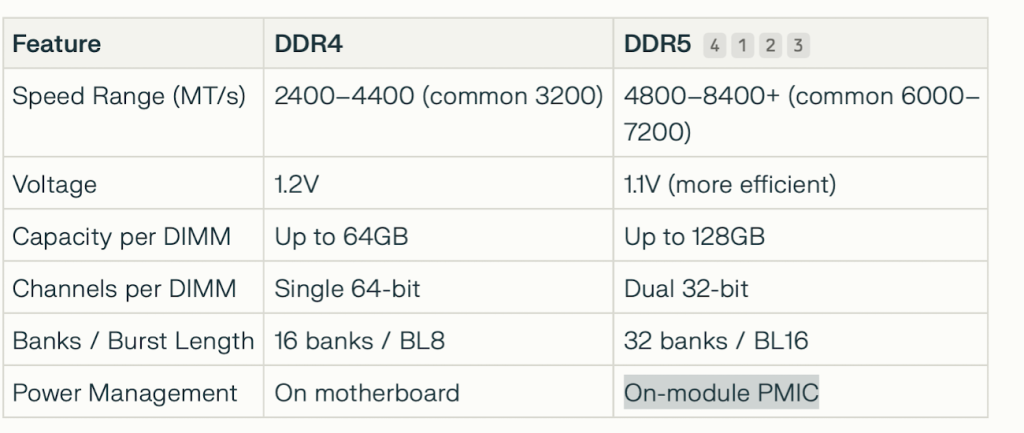
DDR4 and DDR5 RAM differ mainly in speed, efficiency, and architecture. DDR5 starts at 4800 MT/s with dual 32-bit channels per module for higher bandwidth, while DDR4 maxes at 3200 MT/s standard with single 64-bit channels. Take a look at the charts below, we will be going over the current specifications of DDR4 and DDR5. Notice numbers are different and we will explain what each of these numbers mean.
DDR4 Specs and DDR5 Specs listed below
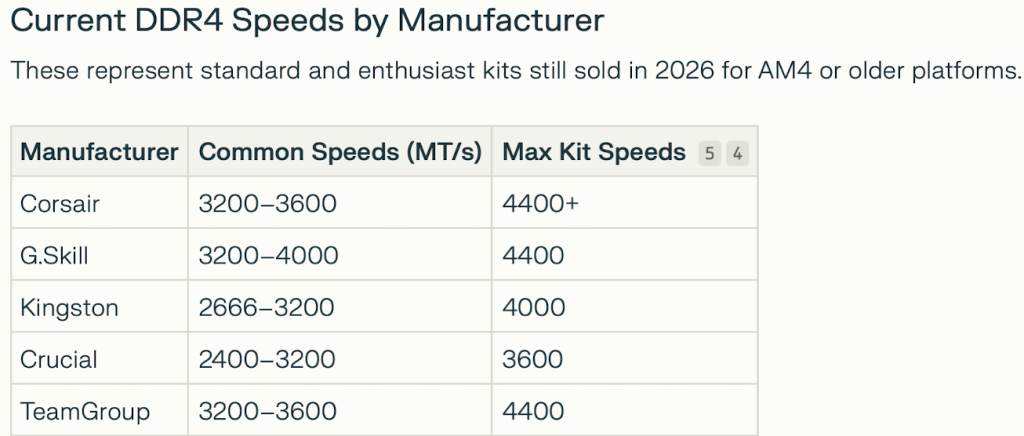
DDR4 in Detail
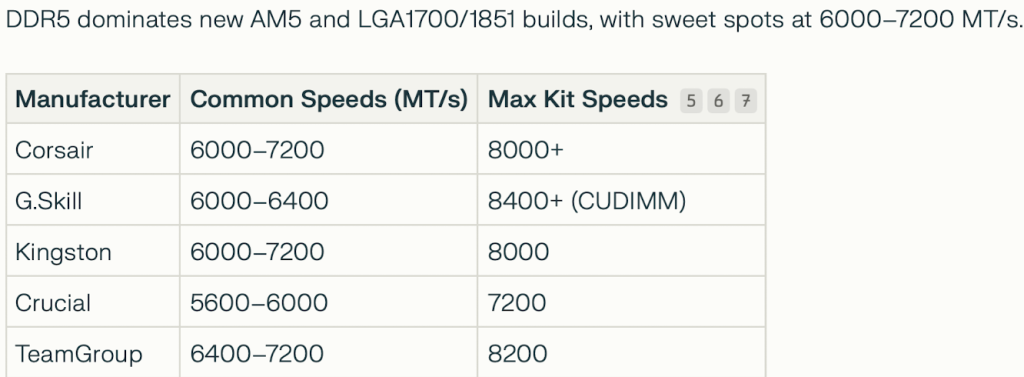
DDR5 in Detail
Why Higher Speed Matters
Higher DDR5 speeds deliver up to 2.5x the bandwidth of DDR4, which matters for bandwidth‑hungry tasks like 4K gaming, video editing, and AI workloads.
DDR5 is better overall because it scales to 8400+ MT/s without instability penalties (via on‑module clock drivers in high‑end kits), runs cooler at lower voltage, and supports larger capacities for future‑proofing.
DDR4 remains viable for budget or legacy builds where 3200 MT/s suffices, as gains beyond that yield diminishing returns without platform support.